24/7 Support
Our team is available around the clock to respond to any urgent transport situation.

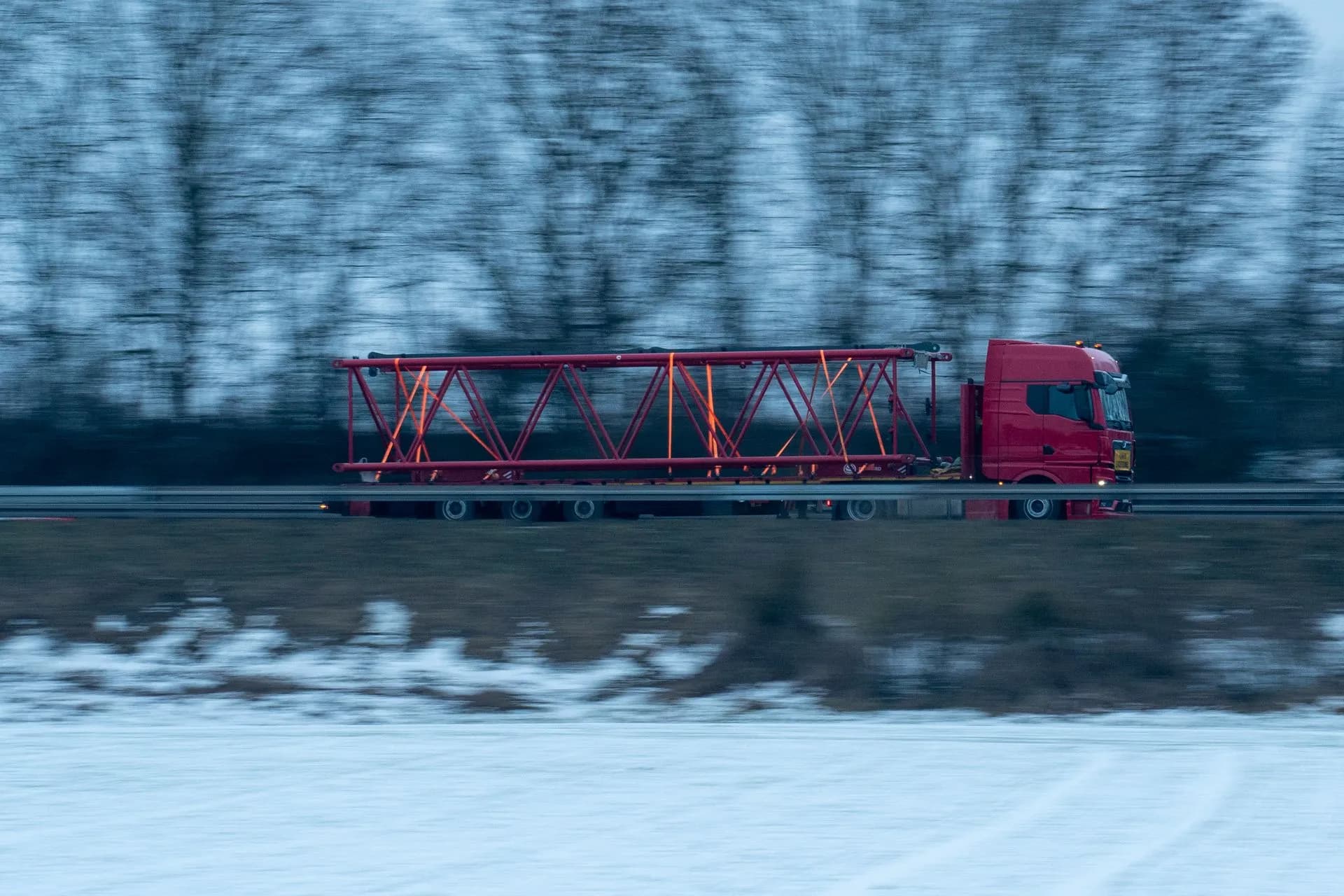
Over 2.55 m wide, 4 m high or beyond the permitted length: route survey, lowbed and multi axle trailers, escorts and permits
Check whether your load is oversized
Enter the dimensions and weight to see which regime the load requires.
Abnormal load transport · Europe
We provide abnormal load and oversized transport for cargo of exceptional dimensions: bulky freight, out of gauge (OOG) loads, abnormal loads and wide loads exceeding 2.55 m in width, 4 m in height or the permitted length.
We plan every oversize transport with a route survey, lowbed and multi axle trailers, police escorted transport and abnormal load permits, including SPMT solutions for the most complex loads.
How we decide
Three criteria settle the configuration, in this order.
For heavy tonnages we choose gondolas with 4 or more axles, which spread the weight evenly and stay within the legal limits on every road structure.
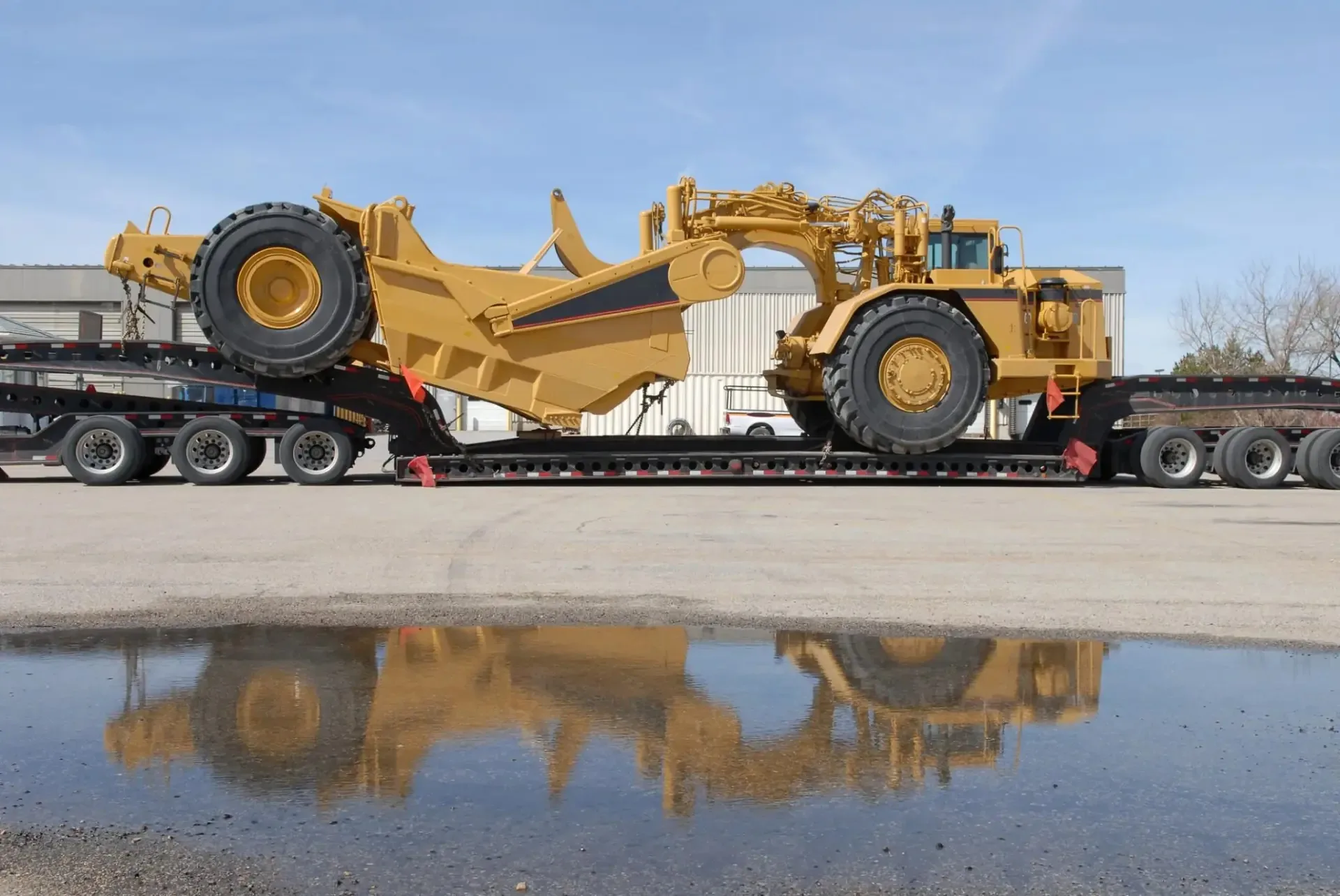
For tall machinery, lowered decks (low bed) bring the loading point down, keeping the overall height under the legal limit of 4 metres.
For long cargo such as wind blades, pipes or beams, we use extendable trailers that adjust to the exact length of the piece.
Three things we settle before oversized cargo takes to the road.
How we work
Five stages, from the dimensions of the piece to the final report.
You send the dimensions, the weight and, if you have them, photos of the equipment.
Together with the partner carrier we select the right type of trailer.
We study the route and obtain the permits required for every country crossed.
We coordinate the escorts and monitor the transport throughout the journey.
Delivery at destination and a final project report.
Industries served
Each industry has its own page, with the equipment and permits that suit it.
Abnormal load transport for wind blades, nacelles and towers.
View the pageAbnormal load transport for tanks, columns and refinery modules.
View the pageAbnormal load transport for construction machinery, beams and cranes.
View the pageAbnormal load transport for transformers and generators.
View the pageAbnormal load transport for mining machinery, mills and industrial furnaces.
View the pageAbnormal load transport for aircraft components and military vehicles.
View the pageAbnormal load transport for yachts and vessels.
View the pageAbnormal load transport for chemical reactors and tanks.
View the pageAbnormal load transport for locomotives and wagons.
View the pageAbnormal load transport for machine tools and presses.
View the pageAbnormal load transport for combine harvesters.
View the pageEvery category of cargo brings its own handling, balancing and securing challenges — and often its own type of trailer.
Specialist equipment
Every exceptional load gets the trailer that suits its weight, its height and its centre of gravity. Through our network of verified partner carriers we have access to a full range of specialist equipment.
A trailer with a completely flat deck, no steps, the right solution for cargo that slightly exceeds the usual envelope but does not need a lowered centre of gravity.
A deck lowered relative to the wheel axis, allowing tall machinery to travel without exceeding the legal limit of 4 metres in overall height.
A low loading area, recessed between the axles, suited to heavy equipment with a wide base. It provides a very low centre of gravity and greater stability over long distances.
The 4-axle version of the low bed gondola, spreading the weight over a larger area and staying within the legal axle load limits even at very high tonnages.
A telescopic chassis that adjusts in length to the piece being carried, the right solution for long cargo such as wind blades, beams or industrial pipes.
A platform with side walls (wells) that frame the wheels of the machine being carried, allowing the overall height to be lowered further, suited to wheeled machinery up to 4 metres tall.
For ultra-heavy pieces such as transformers, industrial modules or marine components, we use Goldhofer or Scheuerle hydraulic modular trailers, which can be coupled into multi-axle configurations to spread loads of hundreds of tonnes.
Pilot vehicles fitted with signalling, beacons and radio communication, compulsory for transports that exceed certain dimensional thresholds on the routes crossed.
Definition & context
Cargo is considered exceptional (abnormal load) when its dimensions or weight exceed the standard limits allowed for free movement on public roads. It is not only about giant machinery: it can be a single industrial piece, a transformer, a tanker, a small vessel or a wind turbine section.
The difference from ordinary road transport is that each such load needs an individual assessment: which vehicle can carry it, which route it can cross without meeting bridges, tunnels or power lines that are too low, and which permits are required in every country crossed. Every request of this kind goes through a dedicated planning team, working with verified partner carriers, before a vehicle is allocated.
The practical benchmark is the standard road trailer, with a usable loading area of roughly 13.6 m in length, 2.45 m in width and 3 m in height. If your cargo exceeds any of these dimensions, it simply does not fit on an ordinary truck and automatically falls into abnormal load transport, with a specialist vehicle and, where applicable, permits.
In short: beyond 13.6 m in length you need an extendable trailer or a pilot vehicle, beyond 2.45 m in width the cargo exceeds the platform's lateral envelope, and beyond 3 m in height a lowered deck (low bed) is normally used. If the combined weight exceeds 40 tonnes, the transport falls under the abnormal load regime anyway: a specialist vehicle, possibly a special transport permit and, above certain thresholds, escorts.
Thresholds and consequences
Length
Standard threshold13.6 m
Extendable trailer or pilot vehicle.
Width
Standard threshold2.45 m
Lateral envelope exceeded, with escorts.
Height
Standard threshold3 m
Lowered deck (low bed), under the legal 4 m limit.
Weight
Standard threshold40 t
Abnormal load regime, with a special permit.
| Dimension | Standard threshold | What exceeding it involves |
|---|---|---|
| Length | 13.6 m | Extendable trailer or pilot vehicle. |
| Width | 2.45 m | Lateral envelope exceeded, with escorts. |
| Height | 3 m | Lowered deck (low bed), under the legal 4 m limit. |
| Weight | 40 t | Abnormal load regime, with a special permit. |
Custom request
Every oversized or heavy move is priced on its own: the route is checked bridge by bridge, permits are issued for the exact dimensions of the piece, and some moves need an escort. A price shown on the spot would be a number with nothing behind it, so we send the quote once a colleague has checked the route.
What to send us so we can quote
We reply on the same working day.
Why us
We are more than a transport provider — we are your long-term logistics partner.
Our team is available around the clock to respond to any urgent transport situation.
We provide quotes and transport confirmations as quickly as possible, without bureaucracy.
All our shipments are fully insured, giving you peace of mind regardless of type or distance.
Transparent and competitive rates, without hidden costs or unpleasant surprises on the invoice.
From pickup to delivery, we manage all logistics for you with full responsibility.
Frequently asked questions
Abnormal load transport and out of gauge cargo call for dedicated equipment and permits. Here is what you need to know.
We carry cargo over 4.5 m wide or over 30 m long, with permits and a double escort. In practice the real limit is set not by the law but by the route: bridges, underpasses, roundabouts and overhead lines. That is why, for every exceptional envelope, we establish feasibility through a detailed route survey before confirming the transport. Useful legislation and resources: Romanian Government Ordinance 43/1997 on the road regime and Directive 96/53/EC on maximum weights and dimensions.
The route survey identifies every critical point, and we propose solutions: diversions, temporarily raising power lines, provisionally removing signage, night-time crossings or even switching to a different mode of transport on the problematic section. Nothing starts before we have validated that the whole route can be travelled safely.
It depends on the envelope: one escort vehicle for medium excesses and two above roughly 4.5 m in width or 30 m in length, plus the traffic police for a major envelope or sensitive areas. On undivided roads the escort travels in front, and on motorways behind. The exact configuration is set by the permit. Useful resource: CNAIR — Special Transport Authorisations (AST).
We assess with the client whether the equipment can be segmented or has to be delivered in one piece. Many items — columns, tanks, generators — cannot be dismantled, and that dictates the entire route engineering and the choice of trailer. Where segmentation is possible, it can significantly reduce the complexity and the cost of the transport.
Transports with a major envelope frequently run at night or outside peak hours, within the windows imposed by the permit, to reduce the impact on traffic. These time windows, along with any compulsory stops, are planned in advance and built into the delivery schedule.
We use low-bed trailers, telescopic or extendable platforms for very long cargo, multi-axle modular trailers and self-propelled SPMT (Self-Propelled Modular Transporter) units for pieces of exceptional dimensions and tonnage. We choose the configuration according to dimensions, weight and load distribution, so that the legal axle limits are respected.
Our team will get back to you in under 2 hours with a personalized quote — no bureaucracy.